Phonics on the Go: Real-Life Games That Combine Listening, Rhythm & Blending – Week 13
You’ve spent the last few weeks building your child’s phonics foundations — from listening for sounds and clapping out rhythms, to playing with rhyme, voice, and early blending.
Now it’s time to bring it all together.
- Intro
- Why this stage matters
- 5 Everyday Routines that are perfect for phonics practice
- Launching our Phase 1 Phonics Activities page
- Greetings from Grace
- Week 14’s Preview
Welcome to the next stage of your phonics journey: helping your child combine the skills they’ve learned in everyday life — not just in planned activities, but on the move, in the moment, and in the middle of real family routines.
This week’s post is all about making phonics work for your day, whether you’re getting out the door, doing the food shop, or stuck in traffic.
This Week’s Skills in Action:
The everyday games we’re sharing this week support:
- Environmental sounds
- Rhythm & rhyme
- Alliteration
- Oral blending
- Vocabulary building
- Listening and attention
🧠 Why This Stage Matters
Your child has built the basic skills — now they’re combining them without even realising it. That’s a big leap forward.
The games below help your child:
- Make sense of sounds in real contexts
- Stay confident and curious about language
- Build the memory and flexibility needed for reading fluency
🟢 Most importantly? They prove that phonics isn’t just something you “teach” — it’s something you live.
🚶♀️🛍️🚗 5 Everyday Routines That Are Perfect for Phonics Practice
Each idea below ties into a real-life UK parent moment — so you can build phonics into your day without adding anything to your to-do list.
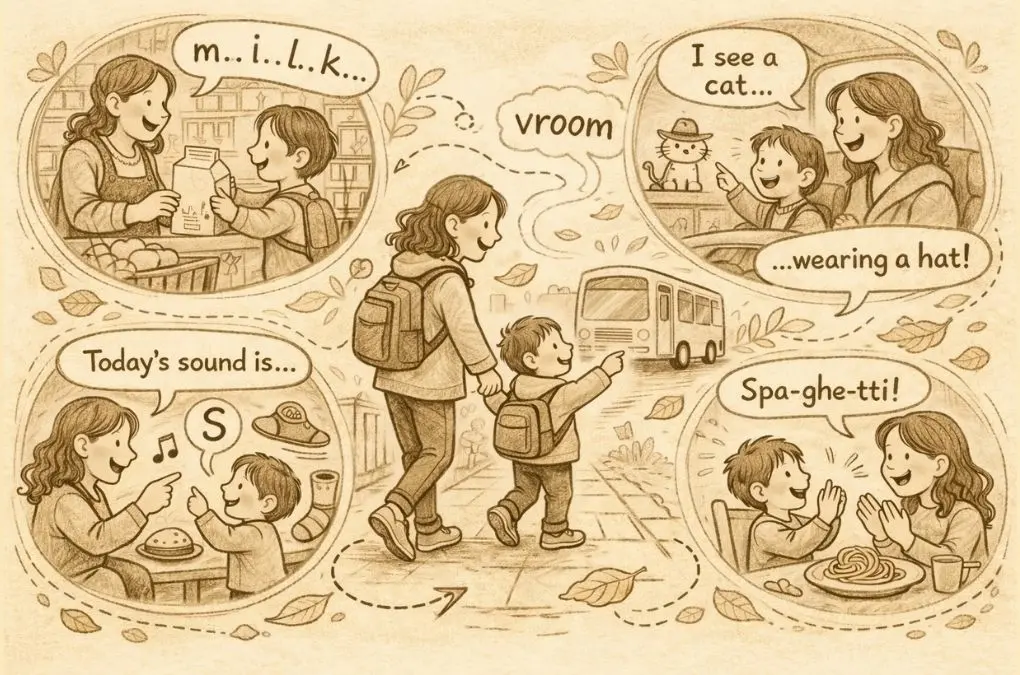
1. On the Way to Nursery or School: “Sound Spotters”
Walks, buggy rides, or even short drives are perfect for tuning into environmental sounds and building vocabulary.
👂 Try this:
“What can you hear right now?”
“Can you hear the birds? Is that a car engine or a bus?”
“Let’s find 3 sounds before we get to the end of the road.”
🟣 Skills combined: Environmental sounds, focused listening, descriptive language
💡 Quick tip: Add a silly twist: “Can you copy that sound with your voice or clap it?”
2. In the Car or Queue: “Rhyme & Repeat”
While waiting at traffic lights, in a queue at the supermarket, or during a slow bit in the car, try this low-effort rhyme game:
🗣️ Start with:
“I see a cat… wearing a hat!”
Let your child finish or continue the rhyme:
“And the hat had a bat… and the bat sat on a mat!”
🟣 Skills combined: Rhyme, rhythm, turn-taking, sentence flow
💡 Quick twist: Challenge each other to find rhyming words that don’t make sense. Laughter is learning too.
3. During a Food Shop: “Robot Requests”
Use oral blending during the shop to make simple sound-based challenges.
🤖 Try this:
“Can you find the /m/ /i/ /l/ /k/?”
“We need some /j/ /a/ /m/ — where could it be?”
🟣 Skills combined: Blending sounds, vocabulary recall, listening for initial sounds
💡 Adapt it: Let your child give you a robot clue too — “Can you get the /e/ /g/ /g/ /s/?”
4. On the School Run: “Alliteration Treasure Hunt”
Set a sound for the journey:
“Today’s sound is /s/ — let’s find things that start with it!”
👀 Your child might spot: socks, scooter, sandwich, seagull.
🟣 Skills combined: Alliteration, sound discrimination, vocabulary building
💡 Make it stick: Choose a different sound each day and turn it into a weekly game: “How many /b/ things can we find this week?”
5. Waiting for Dinner to Cook: “Clap & Say”
Need 5 quiet minutes while the pasta boils? Try clapping out the syllables in family names or food words.
👏 “Spa-ghe-tti!” → 3 claps
👏 “Ben-ja-min” → 3 claps
🟣 Skills combined: Body percussion, rhythm, syllables, segmenting speech
💡 Variation: Let your child “lead” the claps and challenge you to match their beat.
But When Do We Get to the Letter Sounds?!
Hello phonics friends! 👋
It’s Grace again—still here, still talking (and still not giving you my postcode 😄).
Did you know I live in London?
Probably not.
But I bring it up because, well… London moves fast.
Let Me Set the Scene
We’re talking trains every 2–3 minutes.
Ubers circling like bees.
Uber Eats showing up before you’ve even finished deciding what to order.
Convenience is everywhere.
And do you know what I’ve learned from all this fast-paced living?
If you’re not mindful, it can make you really impatient.
Story Time (You Saw That Coming, Right?)
I grew up in an area of London where the tube trains come so often, if you miss one, it’s no big deal—another one’s right behind it.
Then I moved.
Suddenly, the nearest station was a national rail one, with trains every 13 minutes.
Now, 13 minutes is not that long. But when you’re used to 2? It felt like forever.
I’d miss a train by 30 seconds and get so frustrated. Huffing, complaining, checking the time every two minutes. It was a whole thing.
Eventually I realised—it wasn’t the train that was the problem.
It was my expectations.
Why Am I Telling You This?
Because if you’re anything like me, and you’re used to life moving fast, it’s really easy to bring that mindset into other areas—like your child’s learning journey.
You start thinking:
“We’ve been doing these fun listening games for weeks now…”
“Shouldn’t we be onto the letter sounds by now?”
“Isn’t it time to move on?”
And if that’s where your head’s at right now, I get it.
You’re not alone. Those thoughts are completely understandable.
I just want to gently remind you (just a tiny nudge 😉):
You’re already doing the phonics bit.
It just looks a little different at this stage.
Phase 1 Phonics is All About Foundations
All of the clapping, dancing, listening, rhyming, singing, sound exploring—it’s the groundwork. Really important stuff. The fun disguised as learning kind of stuff.
And…
This phase—Phase 1—is usually where children stay throughout Nursery, and sometimes well into Reception.
And This Series?
It’s here to hopefully give you a sense of what’s going on behind the scenes. My hope is that it helps you feel in the loop—so you understand what’s being taught and why, and feel confident supporting it at home.
If your child is starting to show signs that they’re ready for the next bit? That’s wonderful! But if they’re still happily exploring sound in their own way, that’s just as perfect.
Every child deserves to move at their own pace.
A pace where they feel confident, engaged, and curious.
A pace that feels joyful.
This at-home series is here to support that process—not to rush it.
Think of it like a friendly guide, not a checklist.
So, What’s the Plan?
We keep building.
We keep tuning in.
We keep it light, playful, and full of curiosity.
And when your child is ready for those letter sounds?
They’ll meet them with confidence.
📥 Phase 1 Phonics Activities
If you’ve tried searching for Phase 1 phonics activities, and ever thought:
“I wish someone would just show me what to do.”
“I need quick phonics activities I can start today.”
you’re in the right place.
Discover simple Phase 1 phonics activities (with clear instructions) you can try at home to build your child’s listening and sound awareness skills.
👉 [Click here to explore our super practical guide to phase 1 phonics activities!]
Coming Up Next Week…
Next week we’re untangling two phrases that sound confusingly similar:
Phonological awareness and phonics.
They’re connected — but they’re not the same.
And understanding the difference makes the whole journey feel much clearer.
🟡 Read next: Week 14 – Phonological Awareness vs Phonics: Why Phase 1 Phonics Matters for Your Child
If this post made phonics feel a little easier… Get more practical phonics tips, new free resources, and occasional workbook news and special offers sent straight to your inbox.
If you found this post helpful, feel free to share it with another parent who might find it useful too.