- What Are Decodable Books?
- When Should Children Start Reading Decodable Books?
- Why Decodable Books Help Beginner Readers
- Not All Early Reading Books Are Decodable
- Popular Decodable Book Series for Beginners
- Tips for Reading Decodable Books at Home
- What Happens Before Children Start Reading Books?
- FAQs About Decodable Books
At some point when your child is learning phonics, a question often pops up:
“When should my child start reading books?”
I remember wondering exactly the same thing when we first started with phonics at home.
So what have I learned?
Some early reading books are designed so children can sound out the words using phonics. Others rely more on repeating sentence patterns or memorising words.
What I really wanted was for my son to genuinely be able to read the words.
That’s when I first came across decodable books.
Decodable books are written so children can read most of the words using the sounds they already know. Instead of guessing, they practise blending sounds together — just like they do in phonics lessons.
In this guide we’ll look at:
- when children usually start reading decodable books
- what makes a book “decodable”
- and a few examples that parents often find helpful
What Are Decodable Books?
Decodable books are reading books where most of the words can be sounded out using phonics. Instead of relying on pictures or memorising repeated phrases, children practise blending sounds together — the same skill they learn when they are practising phonics.
For example, if a child knows the sounds:
s, a, t, p, i, n
they can read words such as:
sat
pin
tap
pan
Because the words match the sounds children already know, they can often work them out themselves.
For many children, this is the stage when reading suddenly starts to feel quite exciting — because they realise they can actually decode the words on the page.
When Should Children Start Reading Decodable Books?
Children usually begin reading decodable books once they are comfortable with blending sounds together.
Before that stage, they are typically learning to recognise individual letter sounds.
Once blending begins, you might notice your child sounding out simple words like this:
/c/ /a/ /t/ → cat
/p/ /i/ /n/ → pin
Many children reach this stage during Reception once they know several letter sounds and can read simple three-letter words.
If your child is still learning their first sounds, that’s completely normal too. Listening games, rhyming, and practising letter sounds are all important steps along the way.
Why Decodable Books Help Beginner Readers
When children first learn phonics, they need lots of opportunities to practise blending sounds together.
Decodable books give them a chance to practise that skill while reading a real book.
Something many parents notice is how proud children feel the first time they sound out a word in a book on their own.
Even a very simple sentence can feel like a big achievement when a child realises:
“I read that myself.”
Decodable books can help children:
- practise sounding out words
- build confidence
- become more independent readers
- experience early success with reading
If books are too difficult too soon, children often end up guessing words from pictures instead.
Decodable books help avoid that by matching the words to the sounds children already know.
Not All Early Reading Books Are Decodable
One thing that surprised me when I first started looking into phonics is that not all beginner reading books are designed to be sounded out.
Some early readers rely more on:
- repeating sentence patterns
- predictable phrases
- pictures that help children guess words
Those books can still be enjoyable to read together, but they don’t always give children the chance to practise sounding out the words themselves.
Decodable books are a little different because the text is written to match the phonics sounds children have already learned.
Popular Decodable Book Series for Beginners
There are quite a few decodable reading series available. Below are a few that many parents come across when children are just starting to blend simple words.
A quick note before you choose a book or book series
If you’re just starting with decodable books, the first books in the series shown below are the ones best suited for children who are learning Phase 2 sounds.
Always make sure that any book you choose matches the letter sounds your child has been taught at that particular stage of their school’s phonics programme.
At the beginning stage of Phase 2, children are usually introduced to single-letter sounds (such as s, a, t, p, i, n) and may know a few simple “tricky words” like the, to or I.
This means they’re beginning to read simple words by sounding them out. Words like:
sat pin tap sit pat
They may also be starting to read short sentences like:
Sam sat on it.
Dad got it.
The books below are designed so your child can practise blending the sounds they’ve learnt together and start to gradually read with confidence.
It’s completely normal if reading feels slow at first.
Give your child plenty of time to:
- look at each letter
- say each sound
- blend the sounds together
For example:
/s/ /a/ /t/ → sat
This slow, careful sounding out is exactly what you want to see.
Keeping this process calm and unhurried helps build confidence and avoids guessing.
Starting gently at this stage makes a big difference — these early successes are what help children feel like readers.
If a book feels too difficult
If your child starts to guess, loses interest, or becomes frustrated, it usually means the book is a little too challenging right now.
Going back to practising letter sounds or simpler words can help with confidence before trying again.
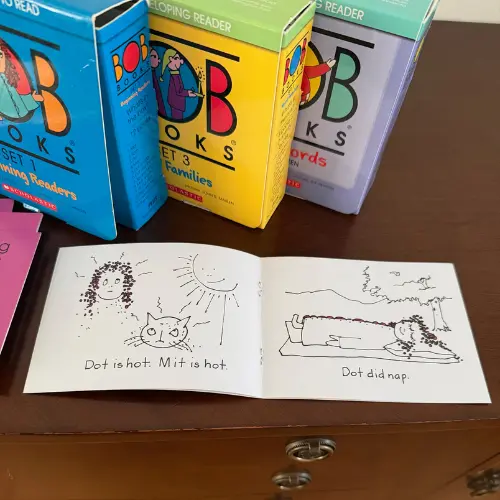
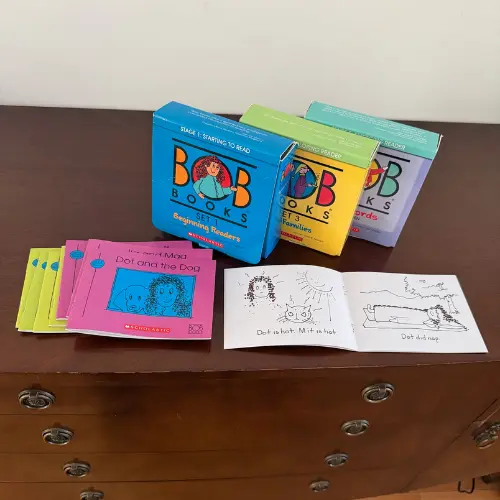
Bob Books
Best for: Children just starting to blend simple words
Phonics stage: Early Phase 2 (single letter sounds)
What this looks like: Very short sentences using simple 3-letter words
Bob Books are one of the sets many parents discover early on, and they are often a helpful place to start when children are just beginning to blend.
A page might look like:
Mat sat.
Sam sat.
Because the vocabulary is so controlled, children can focus on sounding out the words rather than guessing them.
Many parents find these books helpful at the very beginning because children can often read a whole book quite quickly, which can feel like a big confidence boost.
👉 If your child is just starting to blend words like cat and pin, you can have a look inside Bob Books – Set 1 here
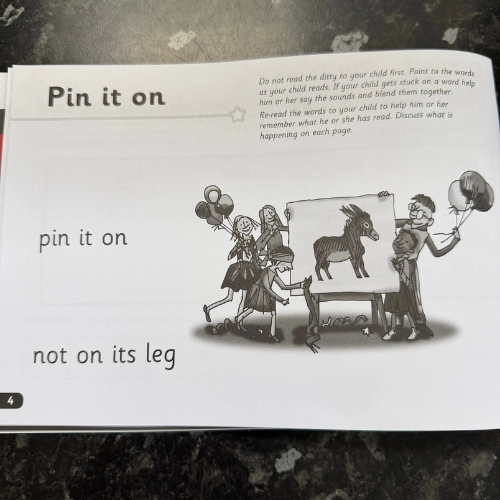
Read Write Inc. Phonics Storybooks
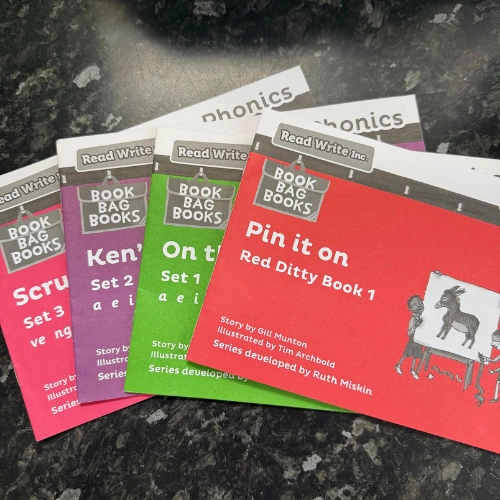
Best for: Children beginning to blend simple words, especially those who benefit from a very structured approach
Phonics stage: Early Phase 2 onwards
What this looks like: Very short, carefully controlled sentences that match the sounds children are learning
Read Write Inc. is one of the phonics programmes used in many UK schools, but the books can also work well at home, even if your child’s school uses a different scheme.
The beginner books, such as the Red Ditty reading books, are carefully matched to the sounds children are learning. This means children are practising reading words that follow a clear phonics pattern, rather than guessing from pictures.
A page might look something like this:
put it on.
zip it up.
Because the text is so structured, children can focus on blending sounds together and reading each word step by step.
Many parents find these books helpful if their child benefits from repetition and practising the same sounds several times.
👉 If your child is just starting to blend simple words and would benefit from a very structured approach, you can explore the Read Write Inc. Red Ditty books here
Collins Big Cat Phonics for Little Wandle
Best for: Children learning phonics in school or beginning to read simple sentences
Phonics stage: Phase 2–3
What this looks like: Simple, carefully matched books that follow a clear phonics progression
Many schools in England now teach phonics using the Little Wandle Letters and Sounds Revised programme.
The matching reading books are part of the Collins Big Cat Phonics for Little Wandle series. These books are carefully written so that children only encounter words that match the phonics sounds they have already learned.
The early books, such as Collins Big Cat Phonics for Little Wandle: Phase 2 readers, contain very simple sentences and familiar phonics patterns. This allows children to practise blending sounds while reading a real story. You can browse a selection of the Collins Big Cat Phonics for Little Wandle Phase 2 beginner readers here.
Because these books follow the same phonics progression used in many classrooms, some parents like using them at home to reinforce the sounds children are learning at school.
Dandelion Readers
Best for: Children just starting to blend simple words or who need lots of structured practice
Phonics stage: Early Phase 2 onwards
What this looks like: Very simple, carefully controlled text that builds gradually
Dandelion Readers are written specifically for children learning phonics.
The books follow a phonics progression so children only come across words that match the sounds they already know.
A page might look something like:
The pot is on Pam.
Pam is in the pot.
Some of the earliest books in the series, such as Phonic Books Dandelion Launchers Units 1–3, are designed for children who are just beginning to blend simple words.
Oxford Reading Tree – Floppy’s Phonics Decoding Practice
Best for: Children beginning to read simple sentences, especially those using phonics at school
Phonics stage: Phase 2–3
What this looks like: Short, structured stories that match phonics sounds and build gradually
Many parents are already familiar with Oxford Reading Tree, especially the Biff, Chip and Kipper stories.
However, those original books are not designed as decodable texts.
If you are looking for phonics-based books within that series, it’s worth looking for the Floppy’s Phonics decoding practice books, such as Floppy’s Phonics Decoding Practice: Oxford Level 1+ Words and Phrases, which follow a phonics sequence and allow children to practise sounding out words.
A page might look something like:
I got the net.
You can also look inside Oxford Level 1+ here to see how the early books are structured.
Songbirds Phonics (Oxford Reading Tree) – Stage 1
Best for: Children beginning to blend simple words and read short sentences
Phonics stage: Phase 2–3
What this looks like: Short, simple stories using carefully matched phonics sounds
The Songbirds Phonics books by Julia Donaldson are part of a structured phonics scheme and are written so that children can sound out most of the words using the sounds they have already learned.
The early stage 1 books use simple sentences and a small number of sounds, which helps children focus on blending while beginning to read short, story-based texts.
A page might look something like:
Bob is a bug.
Bob Bug has a mum. His mum is big.
👉 If your child is beginning to blend simple words and would enjoy short, story-based books, you can explore the earliest fully decodable titles below:
Because the text of the above books are carefully controlled, children can practise sounding out words while also starting to experience simple stories.
You may also come across the above books sold within larger collections. These can sometimes be a more cost-effective option, although the collection may include some books that are not fully decodable at this early stage.
If you’d like to start with the early stage 1 fully decodable titles first and keep the other books in these collections for later phonics stages you can see example collections that include the above fully decodable titles, such as Read with Oxford: Stages 1-2: Julia Donaldson’s Songbirds: My Phonics Story Collection here and Julia Donaldson’s Songbirds Read with Oxford Phonics 36 Books Collection Set (Stage 1 – 4) here.
Tips for Reading Decodable Books at Home
When children first begin reading, the goal isn’t speed — it’s practice and confidence.
A few simple things can help.
Give your child time to sound out words.
Blending can feel slow at first, and that’s completely normal.
Keep reading sessions short.
Five or ten minutes is often enough for young children.
Celebrate effort.
Sounding out even one word independently is a big step.
Don’t worry about reading the same book again.
Repetition helps children build confidence.
Decodable books give children the chance to practise blending in real reading. However, if blending feels tricky, our phonics blending guide offers simple, step-by-step support.
What Happens Before Children Start Reading Books?
Before children begin reading books, they usually spend time building the foundations for phonics.
The early stages often look something like this:
Phase 1 – listening skills and sound awareness
Phase 2 – learning letter sounds and beginning blending
Phase 3 – reading simple decodable books
If your child is currently learning letter sounds, that stage is a very important part of the process.
Practising Phonics Alongside Reading
Decodable books give children a chance to practise blending sounds while reading, but many parents find it helpful to keep practising phonics sounds alongside reading too.
When children become confident recognising letter sounds and blending them together, reading books often starts to feel much easier.
Sometimes a few minutes of phonics practice before reading can make a real difference. It gives children a chance to revisit the sounds they are learning so that they feel more familiar when they see them in a book.
If you are looking for simple ways to practise phonics at home, you might find our free phonics worksheets and early reading activities helpful. They are designed to give children short opportunities to practise recognising sounds and blending words before moving on to reading.
Many parents find that combining phonics practice and short reading sessions helps children gradually build confidence as early readers.
FAQs About Decodable Books
What are decodable books?
Decodable books are reading books written so children can sound out most of the words using the phonics sounds they have already learned.
When should my child start reading decodable books?
Children usually begin reading decodable books once they start blending sounds together, often during Reception.
Are decodable books better than other early readers?
Decodable books can be especially helpful when children are learning phonics because they encourage sounding out words rather than guessing.
Do schools use decodable books?
Many UK schools use decodable reading schemes that match their phonics programme so children practise reading words that follow the phonics sequence.
How many times should my child read a decodable book?
Reading the same book several times is often helpful. Familiarity builds confidence and allows children to blend the words more smoothly.
A Final Thought for Parents
Learning to read doesn’t happen overnight.
Children move from listening to sounds, to blending spoken sounds, to recognising letters, to blending letter sounds into words — and eventually to reading simple books.
Decodable books can be a lovely milestone along that journey, because they are often the moment when a child realises:
“I can actually read this.”
And that small moment of confidence is often what makes reading start to feel exciting.
If this guide has been helpful, feel free to share it with another parent who might find it useful too.