Clap, Tap, Stomp: Body Percussion Games for Early Reading Skills – Week 6
Try this quick phonics game (takes 2 minutes):
Clap a simple pattern (e.g. clap–clap–stomp) and ask your child to copy it.
Then let them create their own rhythm for you to repeat.
👏 = clap
🦶 = stomp
👏 👏 🦶
(clap – clap – stomp)
You: 👏 👏 🦶
Child: 👏 👏 🦶
Now switch!
Child: 👏 🦶 👏
You: 👏 🦶 👏
💡 How does this help my child learn to read?
When your child does actions like clap-clap-stomp, or copies the actions for songs like “if you’re happy and you know it” or “heads, shoulders, knees and toes” , they’re not just moving — they’re practising the same skills they’ll use when reading.
| During the game | This can help with reading |
|---|---|
| Copying “clap–clap–stomp” | Hearing and repeating sound patterns in words |
| Remembering the sequence | Keeping sounds in the right order (c-a-t, rather than t-a-c) |
| They start to break patterns into parts | Just like breaking a word into sounds (e.g. dog → d-o-g) |
| They feel the rhythm | This helps them later hear syllables and word patterns when reading |
👉 In simple terms:
Before children can read letters, they need to hear and organise sounds — and games like these allow them to practise that in a fun, physical way.
- What is Body Percussion in Phonics?
- 5 Fun Body Percussion Activity Ideas
- Free Phonics Activity Worksheet
- Greetings from Grace
- Week 7’s Preview
- FAQs
A simple game like clapping or stomping a pattern helps your child learn to hear and remember patterns in sound.
These patterns are very similar to what they’ll later hear in words.
ba–na–na 🍌
👏 👏 👏
di–no–saur 🦖
👏 👏 👏
🔊 Try clapping your child’s name
Say your child’s name slowly and clap each part:
Em–i–ly 👏 👏 👏
Ben–ja–min 👏 👏 👏
Ol–i–ver 👏 👏 👏
When your child gets used to hearing and copying rhythms like these, it becomes easier for them to notice when words sound similar — like dog and frog, or car and star.
They begin to notice how words have parts, rhythm and patterns.
This is an important step before they start reading, when they’ll need to recognise patterns in words.
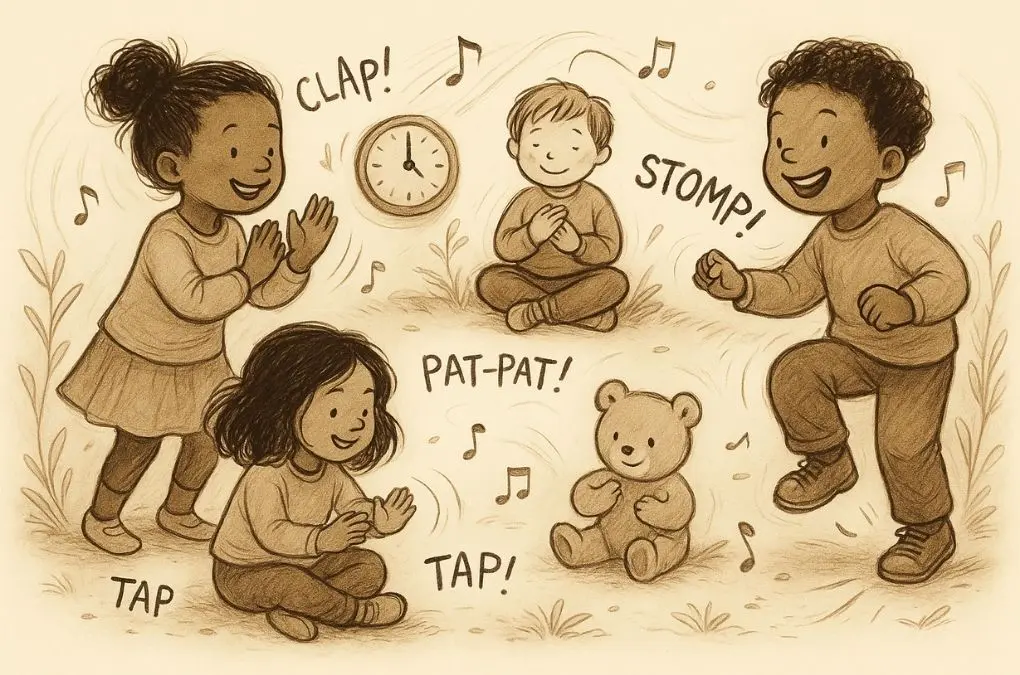
These fun clap, tap, and stomp games (called body percussion) are part of Phase 1 phonics and help build listening, rhythm, and sound awareness — all essential before reading begins.
Intro
When your child starts clapping along or tapping their feet in time to a song, they’re doing something surprisingly clever: they’re learning to listen with their whole body.
In phonics, this kind of sound awareness is called body percussion—and it plays a key role in helping children hear rhythm and patterns in spoken language.
This week, we’re exploring Aspect 3 of Phase 1 phonics: Body Percussion. No instruments. No prep. Just your child, some space to move, and a few playful ideas to spark learning.
What Is Body Percussion in Phonics?
Body percussion involves using parts of the body to make sound:
- Clapping
- Tapping
- Clicking
- Stomping
- Patting
- Snapping
It’s not about music lessons — it’s about helping children:
- Hear and copy rhythms
- Pay attention to timing and sound patterns
- Tune in to differences in sound and beat
- Develop stronger auditory memory
These skills help with phonological awareness — especially hearing syllables and rhythm in words, which supports blending and reading fluency later on.
Why Music and Movement Matter for Phonics
Here’s the thing—when kids move their bodies and hear rhythm and rhyme, they’re actually strengthening the very skills phonics relies on:
- Sound discrimination
- Rhythm and syllable awareness
- Listening and memory
- Coordination (which helps with writing too, eventually!)
It’s play… but with purpose.
And the best part? Your child won’t even realise how much they’re learning—because they’ll be too busy having fun.
5 Body Percussion Games to Try at Home
1. Copy the Beat
Clap or tap a short rhythm (e.g. clap–clap–stomp), and ask your child to repeat it.
Start simple, then try longer or trickier sequences. Switch roles and let them lead.
🟣 Top tip: Use names or favourite words as rhythms (e.g. “ba-na-na” → clap–clap–clap).
2. Sound Statues
Play music and let your child move, clap, stomp, or snap in time with the beat. When the music stops, they freeze!
🟣 Variation: Call out different actions (“Clap above your head! Tap your knees!”) for extra fun.
3. Rhythm Match
Create two short rhythms and ask your child: “Are they the same or different?” For example:
- Clap–tap–clap
- Clap–tap–stomp
🟣 Why this helps: It builds listening accuracy — a key part of sound discrimination.
4. Syllable Steps
Say a word slowly (e.g. el-e-phant) and take a step, clap, or tap for each syllable. Try names, animals, or foods.
🟣 Try this: Use a toy to “jump” each beat with your child.
5. Body Sound Patterns
Assign different body parts to different sounds:
- Clap = /c/
- Stomp = /a/
- Tap = /t/
Then “spell” words with body percussion! For example, cat = clap–stomp–tap.
🟣 Silly twist: Let your child choose the body parts for each sound — then try to keep up!
Download Our Make Your Own Beats Worksheet
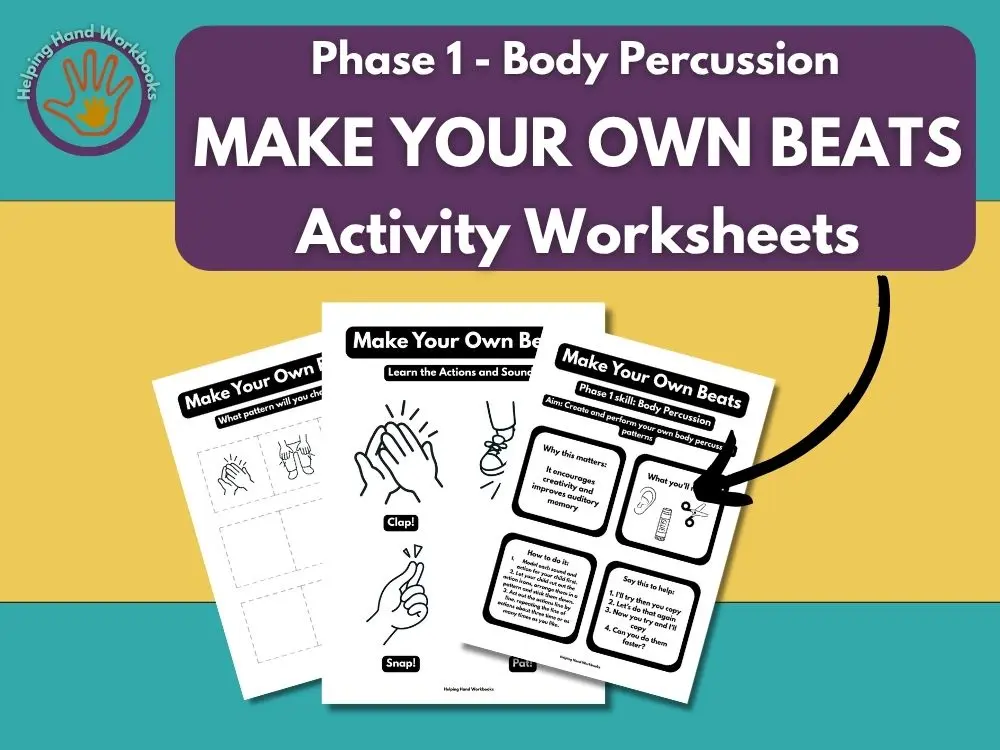
Design your own body percussion beats then act them out!
Want to try a phonics activity today?
Download our free Phase 1 Make Your Own Beats Phonics Activity Worksheet—a fun body percussion activity, perfect for ages 3–5.
[Click here to download]
or explore our phase 1 phonics activities page for more simple listening and sound-awareness activities you can start with your child today.
Music, Movement, and Phonics (AKA Learning With a Beat!)
Hi there—it’s Grace again! 🎉
Have you been loving my new straight to the phonics layout?
(If you’re new here, don’t worry… it’ll all make sense soon.)
This Week’s Vibe? High Energy and Big Fun
We’re diving into how music and rhythm can super boost your child’s phonics journey.
We’re talking practical, energetic, joy-filled activities—lots of movement, lots of noise, and heaps of laughter.
So yep—you’re going to need all your enthusiasm for this one.
Let’s Take a Quick Trip Down Memory Lane
You ever notice how some games never get old?
I’m talking about the classics:
🎶 Musical chairs
🎶 Musical statues
🎶 Pass the parcel
You could be 4 or 44 and still get wildly competitive about that one last chair.
Now, think about what those games all have in common:
Music and movement. Every time.
That wonderful combo of sound and motion has a way of lighting up brains and bodies—especially for little ones.
And this week? Ride that wave of fun and turn it into a powerful phonics learning experience.
So Let’s Get Ready to Move
Get the music ready.
Clear a bit of floor space.
Get silly. Get loud.
And don’t be afraid to join in the dancing, tapping, stomping and clapping. (You know you want to.)
This week is all about celebrating sound and turning your living room into a full-on phonics party.
Coming Up Next Week…
Next week, we’ll explore how simple chats and everyday conversations can help your child build the vocabulary and confidence they need to thrive in phonics and reading.
Read next: [Week 7 – Talking and Listening: Building Vocabulary Through Chat]
FAQs
What is body percussion in Phase 1 phonics?
Using your body to make sounds — clapping, stomping, tapping, patting, or snapping — to help develop rhythm, listening, and sound awareness.
Why is body percussion important for phonics?
It builds auditory memory, helps children hear syllables, and strengthens listening skills essential for blending and reading.
How can I practise body percussion at home?
Play games like Copy the Beat, Syllable Steps, or add claps and stomps to favourite songs.
Do I need music for body percussion games?
No — you can make rhythms with just your voice or body sounds, though adding music makes it more fun.
What comes after body percussion in Phase 1?
Children move on to rhythm and rhyme — recognising and enjoying patterns in songs and spoken language.
If this post made phonics feel a little easier… Get more practical phonics tips, new free resources, and occasional workbook news and special offers sent straight to your inbox.
If you found this post helpful, feel free to share it with another parent who might find it useful too.